


GlobalFoundries and Semilab talk at AVS conference
10.24.2013
GLOBALFOUNDRIES U.S. Inc. and Semilab are to present a joint research talk during the AVS 60th International Symposium & Exhibition on 31 October, 2013. The talk is about recent results obtained with Semilab’s novel ellipsometer porosimeter PS-2000 being capable of extracting thermal expansion coefficients of thin ULK coatings. The abstract of the talk is available in the conference abstract booklet on page 203, and can also be read below.
Ellipsometric Porosimetry Surface Characterization of Oxygen Plasma Damage and κ Repair on Ultra Low-κ Dielectrics
V. Seshachalam, S. Srivathanakul, H. Liu Z. Sun
GLOBALFOUNDRIES U.S. Inc.
A. Bondaz, T. Karpowicz
Semilab
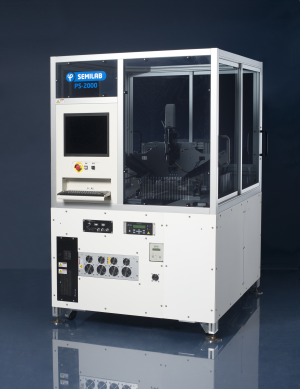 Figure 1. PS-2000
Due to its intrinsic weakness of high levels of carbon-containing compounds and open pores, an ultra low-κ film is prone to Back End of Line (BEOL) downstream damage from processes such as ashing, reactive ion-etching, wet processing and CMP. With continued scaling beyond the 14 nm technology node, κ repair processes become required as an ultimate solution in restoring the dielectric properties and keeping the low κ benefit of low capacitance and power consumption. Oxygen plasma is widely used in the ashing process of photo resist striping, which degrades low-κ material and cause dielectric loss. In this study, ellipsometric porosimetry (EP) has been applied to characterize the ultra low-κ surfaces, which are damaged by oxygen plasma and repaired by subsequent hydrocarbon-sourced plasma. The results of the pore size measured by EP shows a 1.1 nm pore size for a pristine film, 0.4 nm for a repaired film and no pores for a damaged film. The conclusion from these readings indicate that the damaged film has a dense crust on the top of the film, which prevents adsorption of the solvent used in EP. The repair process slightly reopens the pore since it shows a significantly smaller pore size than the pristine film. When low-κ films undergo a heating process, the pristine film shows an approximate linear behavior of thermal expansion, while the damaged film shows thickness shrinkage, which could be explained by the desorption of the –OH containing species formed due to oxygen plasma exposure. The repaired film shows the same trend as the pristine film, with the same extracted Coefficients of Thermal Expansion (CTE) as the pristine film. The penetration of plasma repair has been identified as deep as 30 nm through film stack model fitting. This extensive study proves the κ repair process is taking effect as well as proving ellipsometric porosimetry is capable and sensitive enough to measure the film property changes statically and dynamically.