


Application
CONTAMINATION MONITORING
Semilab’s suite of non-contact metrologies lead the IC industry for in-line detection of ultra-low metallic contamination. Semilab offers full wafer imaging solutions, ranging from the high throughput Photoluminescence Imaging technique (PLI) to more well-established lifetime-based methods, including Suface PhotoVoltage (SPV) and microwave Photoconductance Decay (µ-PCD). The flagship digital SPV technology (FAaST system) is industry standard that leads the world in bulk Fe detection.
There is no disputing the detrimental effect of metallic contamination on the integrity of the critical gate oxide used in integrated circuits. During high temperature processing, contamination in the silicon wafer often precipitates as a defect at the Si/Dielectric interface or segregates to the dielectric – in either case it has the potential to cause premature device failure and a reduction in product yield. The probability of metallic contamination impacting yield is a function of the chip size (e.g. technology node/critical dimension) and the defect density (e.g. the amount of contamination), such that as device dimension decrease, maintaining yield requires a corresponding reduction in contamination. Figure 1 clearly demonstrates the reality of this relationship over the past 25 years, during which time the IC industry has experienced a more than 3 orders of magnitude reduction in typical background Fe concentration observed in new fabs. More importantly the near term projection, where another order of magnitude reduction is needed to meet the requirements of the state-of-the-art Si IC manufacturing, with white pixel reduction in CMOS image sensors being a major stimulus for this effort.
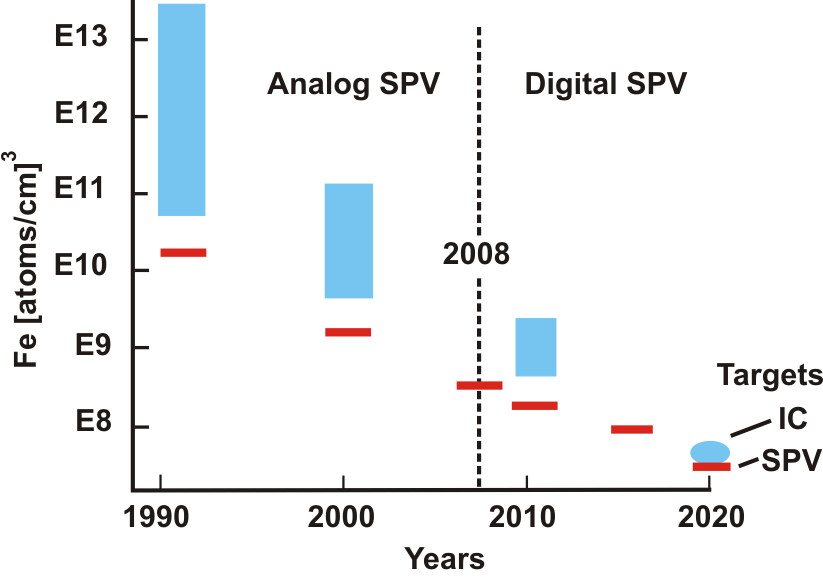
Figure 1. Typical background Fe concentration in new IC Fablines (blue) and the state-of-the-art SPV detection limit (red)
Technology
MINORITY CARRIER DIFFUSION LENGTH MEASUREMENT
Semilab SDI FAaST systems represent state-of-the-art non-contact electrical metrology used in manufacturing control and the development of semiconductor devices and materials. Employing non-contact surface potential probing techniques combined with illumination and/or non-invasive surface charging, these powerful techniques can measure a wide range of parameters characterizing semiconductor wafers, dielectrics and interfaces with astounding precision, while saving cost and time involved in fabricating dedicated test devices.
Due to „historical” reasons, SPV measurement is available in different system platforms. The surprisingly compact designed SPV sensor, integrated into WT-2000 multi-metrology platform contributes to the complete analysis of the electrical quality of the silicon wafers.
Semilab SDI's patented digital SPV technique - in FAaST systems - is the established world-leader for non-contact, non-destructive measurements of heavy metal contamination in silicon. SPV gives extremely fast, reliable measurements of minority carrier diffusion length, at low injection level. Together with proprietary activation techniques, it allows for identification of Cu and Fe contamination with unsurpassed sensitivity.
The small signal ac-surface photovoltage (SPV) minority carrier diffusion length measurement is an important diagnostic method used for monitoring iron contamination and micro defects in silicon wafers. It is used for evaluation of crystal growth, ingot to wafer processing and wafer cleaning. It is also used in IC fabs for monitoring iron contamination during key wafer processing steps and for requalification of processing tools after repair or maintenance.
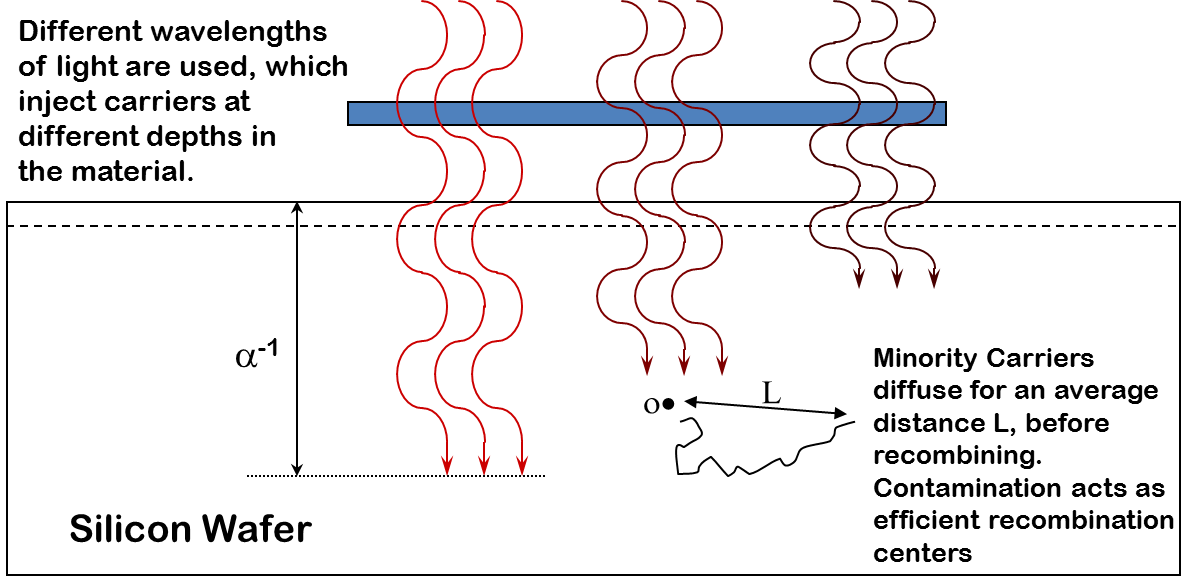
Figure 4. SPV illumination for minority carrier injection and subsequent carrier diffusion.
In ac-SPV metrology, multi-wavelength light, lK , generates excess minority carriers with different concentration profiles beneath the surface as determined by the light penetration depths z K (lK ). The excess carriers recombine and redistribute due to diffusion. The final profile is determined by z and by the minority carrier diffusion length, L = (Dtb)1/2 , where D is the diffusivity and tb is the bulk recombination lifetime. Sensitivity to iron and other recombination centers originates from tb and translates to the diffusion length in such a way that L-2 is a sum of factors proportional to concentrations of the individual recombination centers. Therefore, contamination monitoring is performed by measuring L. Individual contributions of different contaminants like Fe, Cu, and other recombination centers are obtained by manipulation of L-2 measured before and after wafer treatments that selectively change the recombination activity of individual contaminants. Such treatments are known for Fe and Cu and they involve strong illumination and/or thermal treatment.
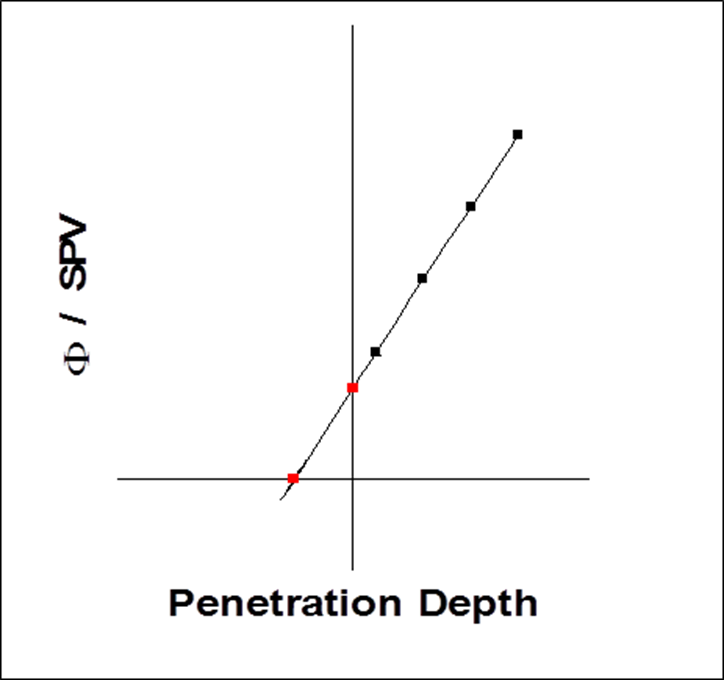 Figure 5. Extraction of diffusion length value (L), from measured SPV signal vs light penetration depth
FEATURES
- Separation and quantitative measurements of:
- Fe concentration; detection limit 108 cm-3
- Cu concentration – from activation of Cu=Cu pairs
- Co concentration (in engineering mode)
- Low carrier injection, constant photon flux approach
- Temperature stabilized digital illuminator (LED)
- In situ diffusion length calibration reference
- Variable intensity digital detrapper
- Ability to measure on bare and oxidized Si wafers
- The only system in the world, which can truly separate bulk minority carrier diffusion length, from front and back surface recombination
- Unique L0 steady state diffusion length measurement
- Precise measurement of steady state minority carrier diffusion lengths up to 3× wafer thickness
- Production-friendly non-contact, non-destructive, including full Si coverage without edge exclusion
- In situ wafer preparation and Fe-B recovery (annealing station)
- Production proven tool to tool matching
Product Line
WT
The WT product line is a powerful tabletop measurement platform for performing many different semiconductor material characterization measurements. The base system includes all the overhead functions necessary to perform characterization measurements, including power supplies, computer and operating software, X-Y measurement stage and so on. It is typically used to make maps, where the wafer is scanned at a programmable raster.
Products
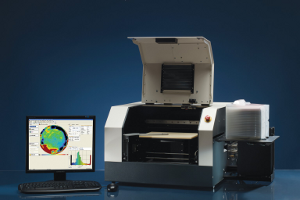
WT-2000
The WT-2000 is a tabletop tool, suggested for mid-range fabs and laboratories.
Features and System Specifications:
- Wafer size: up to 300 mm with bare or dielectric coated surface
- Wafer handling: manual or Semilab-made indexer
- Loading options:
- 100-200 mm cassette indexer
- 300 mm 13 slot cassette indexer, including open cassettes for 100-300 mm wafers
- 300 mm 25 slot cassette indexer, including FOUP, FOSB, and open cassettes for 100-300 mm wafers
- Objectives of detection:
- Impurities due to heavy metal and transition metal contamination
- Crystal defects
- Optional iron concentration determination both in CZ and FZ wafers
- No wafer thickness limitation
- Fast measurement speed
- High lateral resolution
- Required surface passivation: thermal oxide, chemical passivation or corona charging
Each system can be configured based on the user’s requirements by adding measurement capabilities and automation capabilities described below.
Measurement capabilities:
- µ-PCD for measuring carrier lifetime
- SPV for measuring diffusion length
- JPV for measuring ion implants
- Eddy current measurement of sheet resistance
Request Info
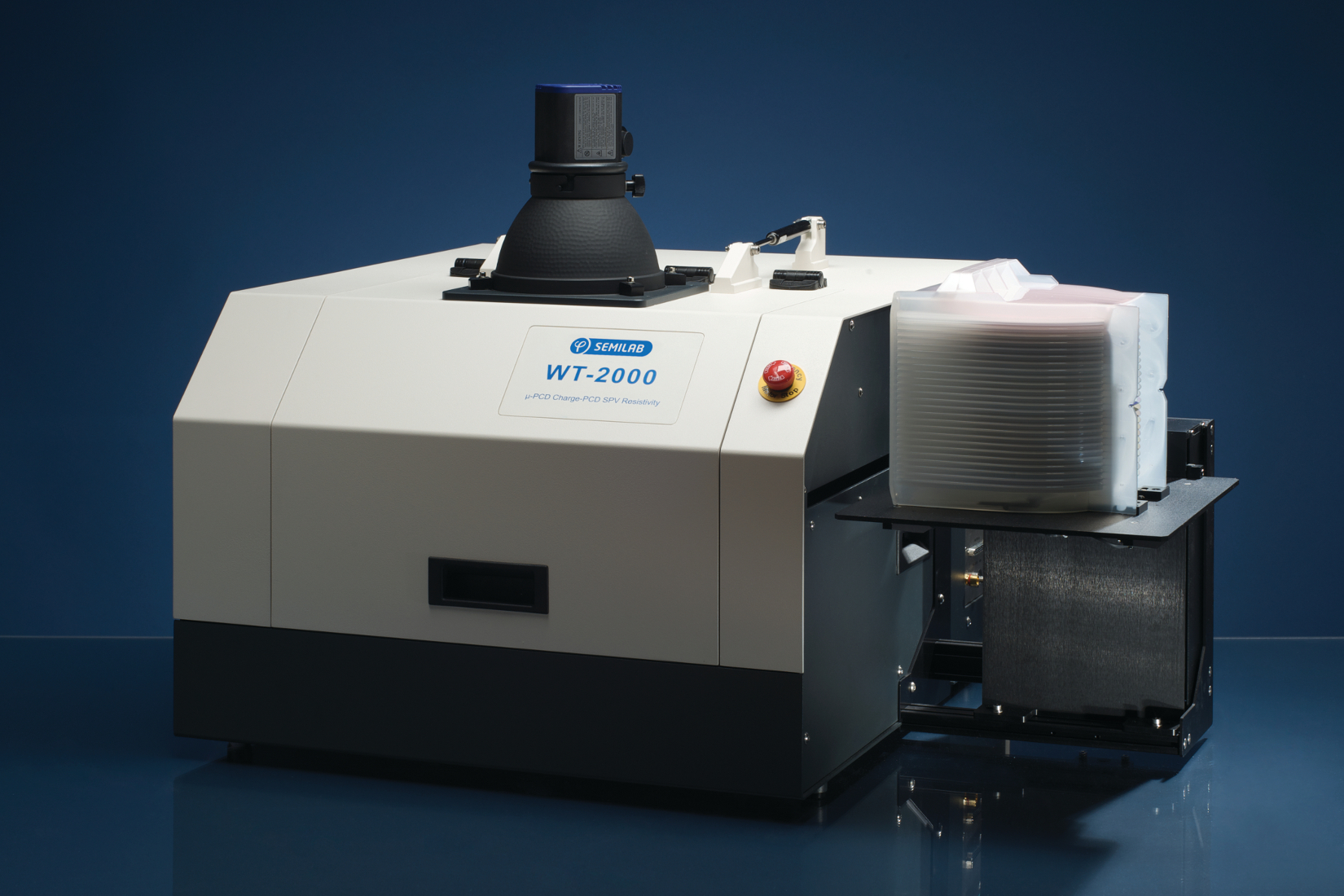
WT-2000 / 2A
The WT-2000 is suggested for mid-range fabs and laboratories.
Features and System specifications:
- Wafer size: up to 300 mm with bare or dielectric coated surface
- Wafer handling: manual or Semilab-made indexer
- Loading options:
- 100-200 mm cassette indexer
- 300 mm 13 slot cassette indexer, including open cassettes for 100-300 mm wafers
- 300 mm 25 slot cassette indexer, including FOUP, FOSB, and open cassettes for 100-300 mm wafers
- Light sources: semiconductor lasers (SPV head with 4 or optional 8 lasers)
- Full mapping
- Point measurements at predefined points
- Sample resistivity: down to 0.01 Ωcm
- Optional bias light:
- High intensity IR LED
- 30 W halogen lamp
- Automatic Iron-Boron Dissociation Unit - for Iron concentration
- Specific measurement performance at specific, programmable locations
Each system can be configured based on the user’s requirements by adding measurement capabilities and automation capabilities described below.
Measurement capabilities:
- µ-PCD for measuring carrier lifetime
- SPV for measuring diffusion length
- VQ for oxide monitoring
- JPV for measuring ion implants
- Eddy current measurement of sheet resistance
Request Info